🔹 What This Guide Covers
Urban driving in Korea involves close interaction with pedestrians, buses, narrow streets, and camera-based enforcement systems. In this guide, you’ll learn how curb markings determine where you can and cannot park/stop, what school zones are, how automated speed and parking cameras are enforced, how city bus lanes function, and what to do if you receive a speeding or illegal parking fine.
Rather than covering every legal exception, this guide concentrates on the rules most likely to affect U.S. service members driving in Korean cities, helping you avoid common mistakes and unnecessary penalties.
When it comes to paying fines, it focuses on the most practical and accessible options for USFK personnel, rather than listing every possible payment method.
✅ Where You Can’t Park or Stop in Korea
One of the key differences from the U.S. is how parking rules in Korea rely heavily on curb markings.
Even U.S. service members who have been stationed in Korea for a long time sometimes receive fines simply because they never fully learned how these markings work.
You might see cars parked along a street and assume it’s allowed.
But in many areas, the legality of stopping or parking depends primarily on the color and pattern of the line painted along the edge of the road.
Understanding those markings is the difference between parking safely and receiving a ticket.
🔍 White Solid Line

If the curb line is white solid, parking and stopping are generally allowed.
However, always check nearby signs.
Line color is the first indicator — not the only one.
🔍 Yellow Double Solid Lines (Two Solid Yellow Lines)

If the curb is marked with double solid yellow lines,
both parking and stopping are prohibited 24/7.
This is considered a strict no-parking, no-stopping zone.
Vehicles parked here can be ticketed or towed regardless of time of day.
If you remember only one rule — remember this one.
🔍 Single Solid Yellow Line

A single solid yellow line generally also means no parking and no stopping,
but in some areas, local governments may allow limited parking during specific hours.
The problem?
Those “allowed hours” vary by location.
If there is no clear time sign posted, assume it’s not safe to park.
🔍 Yellow Dashed Line

A yellow dashed line means:
- Stopping is allowed (briefly)
- Parking is not allowed
In practical terms, that means you can stop temporarily (usually under 5 minutes),
but leaving the vehicle unattended can result in a fine.
🔍 Places You Should Never Park (Even If There’s No Clear Line)
Even if the curb marking looks normal, parking is prohibited in areas like:
- Intersections
- Within 5 meters of a corner
- Near crosswalks
- Within 10 meters of bus stops
- Near fire hydrants or emergency facilities
- School zones
In these areas, enforcement can be immediate.
💡 In many cases, using a public parking lot or a clearly designated paid parking area is the safer option than street parking.
Street parking rules can vary by curb color, time restrictions, and local enforcement, and it’s not always obvious what applies. Public parking lots are usually clearly marked, more predictable, and reduce the risk of tickets or towing.
If you’re unsure about a curb marking, choosing a designated parking lot is often the smarter and less stressful choice.
✅ School Zones

In Korea, school zones are designated around schools and other child-related facilities where children frequently walk.
These zones are usually established within approximately 300–500 meters(328~546 yards) of a facility’s main entrance.
As shown in the image above, school zones are often visually distinguished by red-colored pavement markings on the road surface, making them easier to recognize while driving.
Inside school zones, the key rule is simple:
📌 The speed limit is typically 30 km/h (about 19 mph). On very narrow residential roads, it may be reduced further.
📌 As mentioned earlier, parking and stopping generally restricted. While a small number of cities may allow limited parking during specific times approved by local police authorities, these are exceptions rather than the rule.
For practical purposes, it’s safest to avoid parking in a school zone unless you are absolutely certain it is permitted.
✅ Cameras Are Everywhere

Urban driving in Korea is accompanied by a dense network of automated camera enforcement (CCTV).
In many U.S. cities, traffic enforcement is often associated with police stops or physical parking tickets placed on vehicles. In Korea, enforcement is largely camera-based and processed automatically.
📌Parking Enforcement
Illegal parking and stopping are frequently monitored by:
- Fixed roadside cameras
- Mobile enforcement vehicles equipped with cameras
- CCTV systems in high-traffic areas
In many cases, you may not receive a ticket on your windshield.
Instead, a notice is mailed later to the registered address of the vehicle.
This means that “not seeing a ticket” does not necessarily mean the violation wasn’t recorded.
📌Speed Enforcement
Speed control in Korean cities is also largely automated.
You’ll commonly encounter:
- Fixed speed cameras
- Signal violation cameras
- Section (average speed) cameras in some areas
Because enforcement is camera-based, slowing down only near visible cameras is not always effective — especially in sections where average speed is measured over distance.
When driving in Korean cities, assume that speed limits and parking rules are monitored consistently — even if no officer is visible.
✅ How to Pay Speeding or Illegal Parking Fines in Korea

As mentioned above, fines are usually sent as a paper notice to the vehicle’s registered address in korea.
If you have a Korean bank account, you can usually pay by transferring the listed amount directly to the bank account printed on the notice.
💡 (The depositor name is generally not critical, so if needed, you may ask a trusted KATUSA in your unit to transfer the amount on your behalf and reimburse them in cash.)
Even without a Korean bank account, there are simple ways to handle the payment.
🚗 If It’s a Rental Car 🚗
If the vehicle is a rental, you usually don’t need to pay the notice directly.
In most cases, the rental company pays the fine first and then charges the amount (sometimes with an administrative fee) to the credit card on file.
You may receive an email or separate notification from the rental company regarding the charge.
🚘 If It’s Your Own Vehicle 🚘
If the fine notice is mailed to your address and you do not have a Korean bank account, the easiest options are:
1️⃣ Pay in Person at a Post Office
Bring the original fine notice to a Korean post office.
You can pay the amount in cash (KRW) at the counter.
This method does not require:
- A Korean bank account
- Korean online payment access
- A Korean-issued credit card
For most USFK personnel, this is the simplest and most straightforward option.
2️⃣ Pay at a Bank Branch in Cash
You may also visit a Korean bank branch and present the fine notice.
Payment in cash is generally accepted.
This works similarly to paying a utility bill — the notice functions as a payment slip.
Final Reminder
Do not ignore the deadline listed on the notice.
Paying within the designated period helps avoid additional penalties or collection complications.
✅ Urban Bus-Only Lanes in Korea (City Roads)
In major Korean cities, bus-only lanes are commonly used to improve traffic flow and maintain bus schedules.
These lanes are marked in blue and follow different rules depending on their location and line type.
City bus-only lanes are generally divided into:
- Central Bus-Only Lanes
- Curbside Bus-Only Lanes
📌 Central Bus-Only Lanes
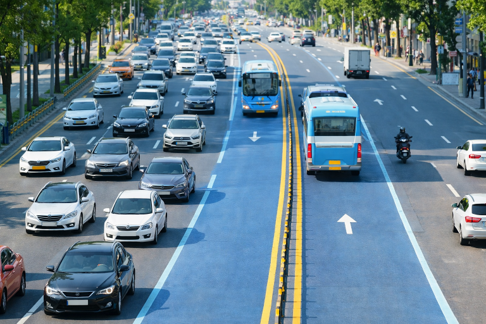
These lanes are located in the center of the road, and bus stops are typically built in the middle as well.
Key rule:
Central bus lanes operate 24 hours a day, 365 days a year.
That means:
- General passenger vehicles may not use them at any time
- Entering these lanes will typically result in automatic enforcement (CCTV monitoring is common)
There are no weekend exceptions for central lanes.
If you see a bus stop island in the middle of the road, assume that lane is off-limits at all times.
📌 Curbside Bus-Only Lanes

These are located along the right side of the road, and they are identified by blue solid lines.
There are two types:
🔵 Double Blue Solid Lines

This indicates a full-time weekday lane.
Operating hours (typically):
- Weekdays: 7:00 AM – 9:00 PM
Outside those hours (9:00 PM – early morning), general vehicles may use the lane.
On weekends, these lanes are usually open to regular traffic.
🔵 Single Blue Solid Line

This indicates a time-based bus-only lane, usually during rush hours.
Typical operating hours:
- 7:00 AM – 10:00 AM
- 5:00 PM – 9:00 PM
These are commuter-focused restrictions.
Outside those time windows, general vehicles may use the lane.
🔍Practical Reminder
Unlike highway bus-only lanes, city bus lanes are more time-dependent and vary by line type.
If you’re unsure whether:
- It’s a weekday
- The restriction is currently active
- The lane is central or curbside
It is safer to stay out of the bus-only lane.
In many cities, enforcement is camera-based, and violations typically result in mailed fines.
Frequently Asked Questions (FAQ)
❓ Do motorcycles follow different rules in city traffic?
A. Yes — and this can surprise U.S. drivers.
Delivery motorcycles often:
- Filter through traffic
- Move between lanes
- Use narrow spaces
While not always strictly legal, this behavior is common in dense urban areas.
Stay predictable and avoid sudden lane changes.
❓ Is honking considered aggressive?
A. Not necessarily.
In Korea, a quick horn tap often means:
- “The light turned green”
- “You can go”
It’s usually not meant as road rage.
❓ Are police traffic stops common?
A. Compared to the U.S., random roadside stops are less common.
Most enforcement is:
- Camera-based
- Automated
- Mailed later
Many drivers receive tickets without ever being pulled over.
❓ Can dashcam footage be used against you?
A. Yes— in Korea, dashcam footage is commonly used as evidence, and insurance companies rely heavily on it. If you are involved in an accident, the other driver may immediately request your dashcam footage, and refusing can complicate insurance processing. This practice is more normalized in Korea than in many parts of the U.S.