
🔹 What This Guide Covers
Now that you know how to find public-transit routes in NAVER Map and have a solid basic understanding of the subway system, it’s time to understand the bus system.
In Korea, the subway can get you to most major areas, but buses often fill the gaps: they can replace subway segments in some cases and, more often, help you get closer to your final destination after you get off the subway.
This page provides a concise overview of the essentials and will help you understand the Korean bus system more clearly and prepare for common mistakes before they happen.
✅ Bus Types in Korea (Color System + Fare Basics)
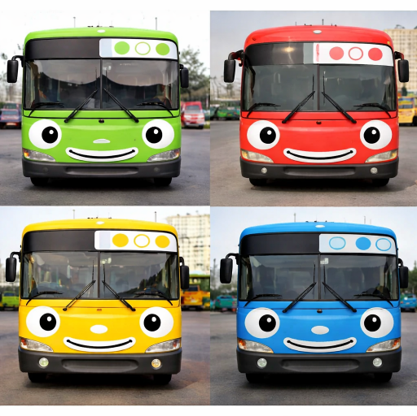
Korean buses are color-coded by role, so once you know the category, it becomes much easier to understand what each bus is designed for.
🔵 Blue Bus (Main City Route) (Trunk Bus)
Blue buses are generally used for traveling across major parts of large Korean cities over longer distances.
These buses connect outer districts, downtown areas, business centers, and major transportation hubs. Because they mainly operate on larger roads and cover wide sections of the city, they are usually faster and more consistent than smaller neighborhood routes.
In many cases, this is the type of bus you would use when traveling between major areas of a city rather than staying inside one neighborhood.
🔴 Red Bus (Metropolitan/Commuter Rapid Bus)
Red buses are long-distance commuter buses that connect major cities with surrounding suburban areas. (Ex : Seoul <> Suwon , Seoul <> Yongin)
They are commonly used by commuters traveling into large cities from nearby regions or satellite cities. Because these buses often travel long distances and use highways, they are designed for faster movement between cities and outer metropolitan areas.
In simple terms, red buses are similar to regional commuter buses used for daily travel into major urban centers.
🟢 Green Bus (Neighborhood Connector) (Branch Bus)
Green buses are mainly used to connect neighborhoods to subway stations or larger bus routes.
These buses commonly operate inside residential areas and help passengers transfer to blue buses or major subway lines. In many situations, this is the type of bus you would take from an apartment area or local neighborhood to the nearest subway station.
If you are in an unfamiliar area and simply want to reach the closest subway station, taking a 4-digit green bus is often a good option, especially in larger cities like Seoul.
🟢 Maeul Bus (Small Local Village Bus)
Maeul buses are small local neighborhood buses used for very short routes inside residential areas.
They usually operate on narrow streets or smaller roads where larger buses cannot easily enter. These buses mainly help connect apartment complexes, hills, quieter neighborhoods, and residential areas to nearby subway stations or larger bus stops.
Unlike regular green buses, Maeul buses are usually much smaller and often have shorter, simpler routes focused on one local neighborhood area. In many cities, they are also easy to recognize because the bus number often starts with a village-style numbering system rather than the typical 4-digit green bus format.
🟡 Yellow Bus (Downtown Circulation Bus)
Yellow buses are short-distance circulation buses mainly used inside busy downtown or commercial areas.
Rather than traveling long distances across the city, these buses are designed for short movements between nearby business districts, shopping areas, office zones, and popular central locations.
Compared to blue or red buses, yellow buses are relatively uncommon and are mostly seen in dense downtown areas.
🔍 Fare difference (simple version)
- Red bus: About ₩3,200 (about $2.20)
- Blue/Green bus: About ₩1,500 (about $1.03)
- Maeul bus: About ₩1,200 (about $0.83)
(USD is approximate and can vary by exchange rate.)
Even though fares differ by type, transfers between subway ↔ bus ↔ different bus types are generally compatible when you tag correctly, and in many cases the additional amount is relatively small.
So practically, you don’t need to memorize every fare rule—just understand what each bus type is for, and let NAVER Map choose the best route for you.
✅ How to Find the Right Bus at a Korean Bus Stop
At busy bus stops in Korea, multiple routes often stop in the same area, so it can feel confusing at first.
Some stop names are similar, and boarding positions may be slightly different even within the same zone.
To make it simple, check information from two places:
1️⃣ At the bus stop display board

See the electronic board at the stop to check the real-time arrival list (for example, “arriving soon”). While checking the board, verify the bus number carefully so you don’t board the wrong route.
2️⃣ In NAVER Map
Use NAVER Map to confirm:
- Direction/destination
- Your exact boarding point
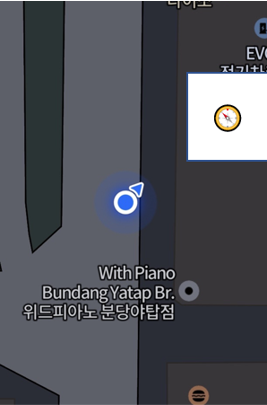
NAVER Map also works like a compass based on your phone’s orientation, so you can tell which way you’re facing and match yourself to the correct stop side more easily.
Even when stop names look similar, the actual boarding side can differ.
So before boarding, match your live location and facing direction in NAVER Map, then confirm once more with the stop display board and bus number.
🔍 Waiting for Red Buses at Bus Stops

When waiting for certain red commuter buses, you may sometimes notice that the bus stop floor has specific bus numbers marked on the ground. These markings show where passengers typically line up for each bus route.
For example, if you are waiting for a bus such as 8201, you can simply stand near the area where “8201” is written on the ground and wait there. This system helps organize lines during busy commuting hours, especially for popular red buses that travel long distances between cities and suburbs.
However, not every bus stop in Korea uses this system. Some stops have these numbered waiting areas, while others do not. In most cases, this type of ground numbering is mainly associated with red commuter buses rather than regular local city buses.
✅ How to Know When to Get Off
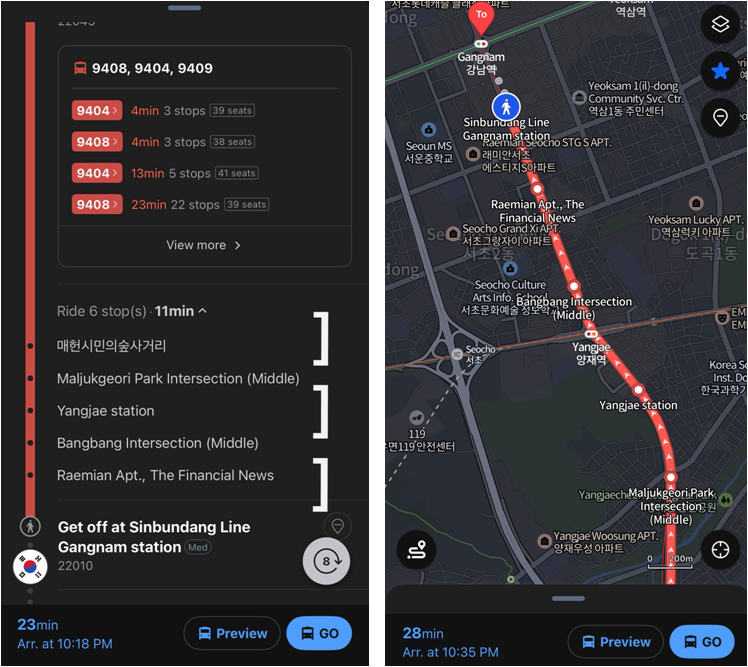
One of the easiest ways to know when to get off the bus is by using NAVER Map’s real-time navigation screen while riding.
When you search for directions in NAVER Map, the app shows the full list of bus stops that your route will pass. During navigation, the map also displays each bus stop as small white circles along the route, allowing you to visually track where the bus currently is.
As the bus moves, you can compare your real-time location on the map with the remaining stops shown on the route. This makes it much easier to understand how far you are from your destination and when you should prepare to press the stop button.
✅ How to Get Off the Bus
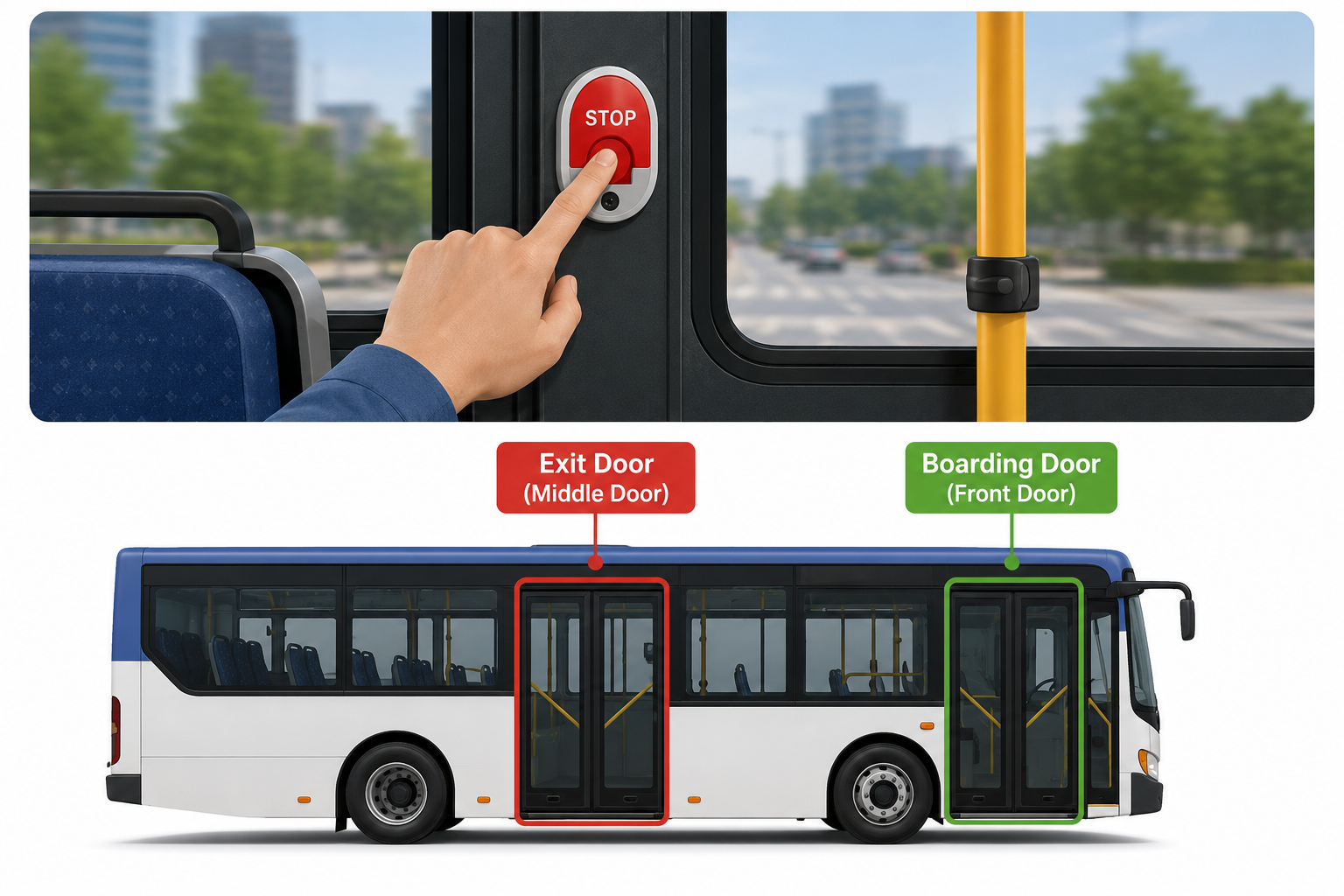
It is common for buses in Korea to simply continue driving if nobody at the bus stop is waiting to board and nobody inside the bus has pressed the stop button. Because of this, if your stop is next, you should press the red stop button before the bus arrives at your stop.
When using NAVER Map navigation, it is a good idea to watch the real-time location tracking carefully and press the stop button slightly in advance once NAVER Map shows that your destination stop is next.
Most regular city buses in Korea use front-door boarding and middle-door exiting. The middle door is generally considered the exit door, so passengers should normally board through the front door near the driver.
✅ Tap In / Tap Out Rules (and Why It Matters)
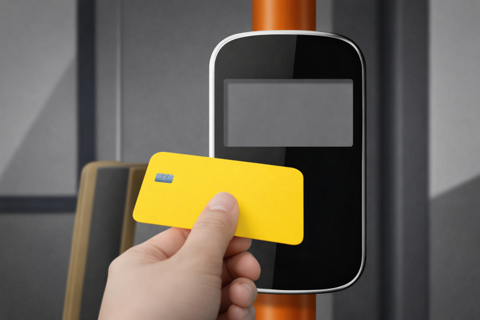
In Korea, card tagging is not just a payment step—it’s how the system calculates your fare and transfer benefits correctly.
So for buses, the rule is simple but very important:
- Tag when you board
- Tag when you get off
If you forget to tag out, the system may not recognize your trip properly, and your next fare/transfer discount can be affected.
In short, missing tap-out is one of the most common bus mistakes for first-time riders.
🔍 Why this matters for transfers
Transfers between subway and bus (or bus to bus) are generally connected through the same card system.
That means your transfer logic depends on clean card records.
So whenever you move between transit modes, remember:
- Tag in at the start of each ride
- Tag out at the end of each bus ride
- Don’t assume the system will “auto-fix” a missed tag
✅ If You Missed Your Stop
- Get off at the next stop
- Cross safely to the opposite direction stop
- Re-route in NAVER Map
This is normal—even locals do it.
✅ Bus Etiquette

- Let people get off first
- Keep calls short/quiet
- Avoid blocking aisles
⚠️ In Korea, open-top drinks (like Starbucks cups with straw lids) are generally not allowed on buses. If you try to board with one, the driver may refuse boarding. To avoid issues, finish your drink first or use a fully sealed container before getting on.
Frequently Asked Questions (FAQ)
❓ Do transfer discounts work forever?
In most cases, transfer discounts apply if you board the next bus/subway within 30 minutes after tagging out.
During late-night hours (9:00 PM–7:00 AM), the transfer window is extended to 60 minutes after tagging out.
You can transfer up to 4 times (for a total of 5 rides/vehicles) within the same trip chain.
❓ Is there a “night bus” option after regular service hours?
In some areas (especially major cities), night routes may exist.
Check NAVER Map late-night route options before traveling and don’t assume normal daytime frequency.
❓ What should I do if I leave something on the bus?
Note the route number, time, direction, and boarding/alighting stops as quickly as possible.Then contact the relevant bus company or local lost-and-found channel with those details.
❓ Can buses be delayed even when the app says “arriving soon”?
Yes. Traffic lights, congestion, and road conditions can shift ETA in real time.
Treat ETAs as live estimates, not guaranteed times.