
🔹 What This Guide Covers
- How Korea’s healthcare system differs from the U.S.
- What it actually costs without insurance
- Where to go depending on your condition
- What to expect when getting medication
✅ How Korea’s System Feels Different from the U.S.

If you’re used to the U.S. system, the biggest difference in Korea is speed and simplicity.
In the U.S., healthcare usually involves scheduling appointments, dealing with insurance, and waiting — sometimes for days or even weeks. Even after seeing a doctor, getting medication can be another separate step with additional waiting.
In Korea, that entire process is much more direct.
You can usually walk into a clinic without an appointment, see a doctor within a short time, and pick up your medication within minutes at a nearby pharmacy. The system is still technically separated (doctor → prescription → pharmacy), but in practice, everything is tightly connected and happens quickly.
Another major difference is cost.
Most U.S. servicemembers won’t use Korean national health insurance, but even without insurance, healthcare in Korea is still significantly cheaper than what you’d expect in the U.S.
✅ How the System Works in Practice
In Korea, healthcare is structured in tiers, and where you go depends on how serious your condition is.
For most situations, you’ll start at a small local clinic. These are everywhere, require no appointment, and handle the majority of everyday medical issues.
If your condition needs more specialized care, you can go to a general hospital, which offers more equipment and access to specialists. For serious conditions or surgery, large university hospitals are available, but they are slower and typically used for more complex cases.
The overall system is designed to be fast and accessible first, with more advanced care available when needed.
✅ How the System Works (Quick Flow)

When you get sick in Korea, the process usually looks like this:
- Walk into a local clinic (no appointment needed)
- See a doctor (usually quick)
- Receive a prescription
- Go to a nearby pharmacy
- Get your medication within minutes
👉 For more serious conditions:
- Clinic → Hospital → University Hospital (if needed)
✅ Cost (No Insurance, Realistic Range)
Most U.S. servicemembers do not use Korean national health insurance, so you’ll usually pay out of pocket.
However:
Even without insurance, basic visits in Korea are still much cheaper than in the U.S.
Typical costs (for routine clinic visits):
- Basic clinic visit: ₩10,000–₩30,000 ($8–$25)
- Clinic visit + medication: ₩20,000–₩50,000 ($15–$40)
- Specialist visit (hospital level): ₩30,000–₩80,000 ($25–$60)
👉 These numbers apply to simple outpatient cases (e.g., cold, minor issues).
👉 Procedures, imaging (MRI/CT), or surgery can be significantly more expensive, so costs will vary depending on treatment.
✅ Where to Go

1️⃣ Clinics (동네 의원)
👉 Best for:
- Cold, flu, minor injuries
- Skin issues, basic care
- Fastest option
- Cheapest
- No appointment needed
2️⃣ General Hospitals (중형 병원)
👉 Best for:
- Specialists (ENT, orthopedics, etc.)
- More detailed exams
- More equipment
- Still relatively quick
3️⃣ University Hospitals (대형 병원)
👉 Best for:
- Surgery
- Serious conditions
- Complex diagnosis
- Longer wait times
- Sometimes require referral
👉 Not for minor issues.
✅ Important: Lunch Break
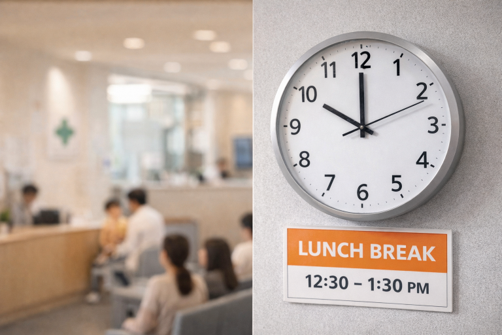
Most clinics and smaller hospitals:
👉 Close for lunch (usually around 12:30–1:30 PM)
- You may not be able to check in
- Or you’ll have to wait
👉 This is normal in Korea.
✅ Pharmacies (Quick Note)
- Prescription required for most medications
- Pharmacies mainly fill prescriptions
👉 In Korea, you can almost always find a pharmacy right next to a clinic.
👉 In areas where multiple clinics are grouped together, it’s common to see 3–4 different pharmacies in the same area.
👉 For OTC meds, refer to your separate guide.